Content note: This piece discusses workplace bullying, ableism, and financial hardship.
A small piece of writing I wrote while crying in my local cemetery after handing in the last of my equipment to my old job, which ended under ignominy. The title is taken from a gravestone that made me stop and pause and consider its meaning. It was different from the other gravestones that often said, “Rest in Peace” or “Deserving of Rest.” There was a kind of finality to “Peace at Eventide” that I appreciated. While the other phrases describe the helplessness of humanity to external forces like death, “Peace at Eventide” is confident: it will happen, and there will be peace. I like that.
I handed in my laptop at my old workplace today. At first it felt like a weight had been lifted. I handed it to the awkward receptionist and I didn’t look back. There was a sense of lightness, fairness, achievement like I had won the emotional battle if not the war of wills. Even if I lose my employment tribunal, this feels like a victory.
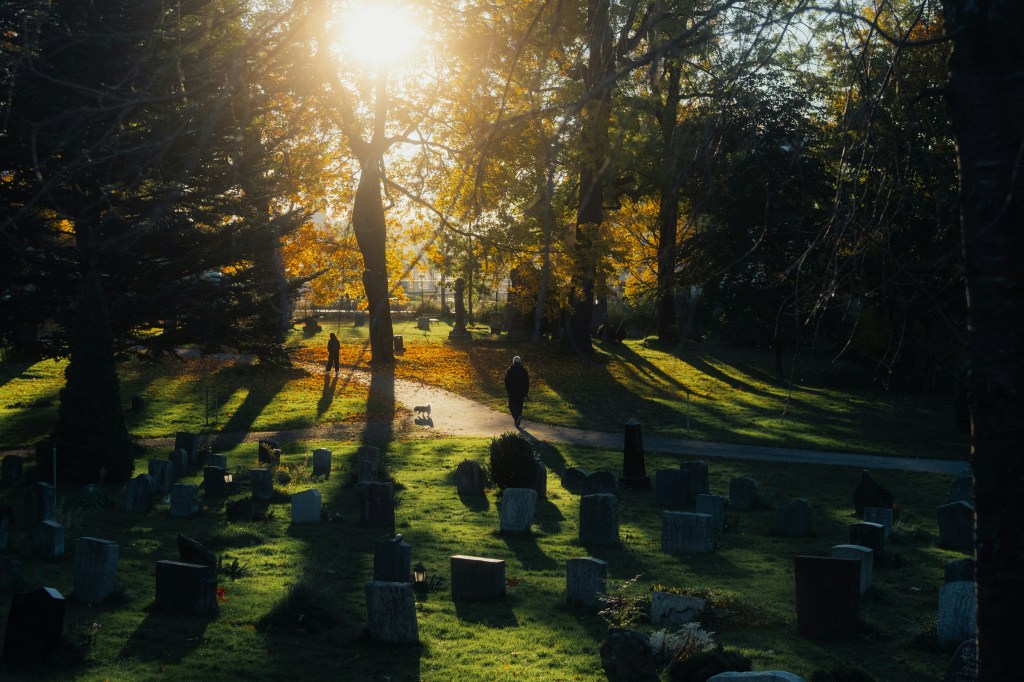
There is a cemetery across the road from my former workplace. I decided to detour there, as I have been told by my physiotherapist I need to lose some weight to help with the agonising pain in my lower back. This time exactly a year ago I had waited anxiously for my job interview in this cemetery, full of hope that only the change in the autumn leaves had promised. Rebirth. A fresh start.
It was not to be. Again. I have lost track of all the fresh starts I’ve had in life. Now, I hang my head as I walk through this cemetery on a mild October day. I am ruminating on how my entire life has felt like one big humiliation ritual. I quit my job a few weeks ago, after I was forced to sign off sick for an extended period of time following a bullying and harassment campaign as well as severe disability discrimination orchestrated by my manager. There were also aspects of workplace mobbing, a trainer who flirted with me one moment and dropped me the next and the ever-present autistic feeling of never being in the “in group” at work. There was lots more. Like getting told I had ruined multiple Christmases, or that I would be personally responsible if the caller committed suicide. Abuse, every day, from customers and managers alike. That was the gist of it.
Retrospectively, I hated that job. I was good at the people element, which was ironic given my autism. I was frequently given high ratings for customer service but I took a long time to process the call, and type up my notes, which meant high “After Call Work.” A big no-no in call centres.
Instead of being offered support, I was accused of call dodging, or “call avoidance” as it’s known in the ultra-productive call centre environment: like it’s crazy to want to avoid being screamed at after someone just threatened to kill you on a call. I could write a whole article on the ethics of call centres and the dehumanisation of call centre staff, but this was less about the job and more about me. In truth, I have struggled in almost every job I have ever had, struggled to get to grips with processes and follow nonsensical rules. I have struggled to fit in with the status quo and understand why some people just aren’t worth challenging, particularly toxic leadership.
I pace the cemetery slowly. Ethel Cain is playing. It’s a slow burn. I want to cry but the tears just won’t come. Maybe I’m embarrassed about crying in a cemetery when I’m mourning no one except myself. It feels like a performance, a fraud, which is ironic because I was working in the fraud department, so I should know.
The tears do come eventually. Behind my eyes, I catalogue a lifetime of suffering and exclusion. On my walk to my old workplace to drop off my gear, I was remembering being a sick kid in high school. After I threw up on the curtain in the nurse’s office, my step-mum begrudgingly drove me home. When I got home though she said I couldn’t use the computer, couldn’t watch TV or even read a book because: “If you are so sick, you wouldn’t be able to do that.” Nowadays, some of my favourite sick day activities include watching movies and listening to audiobooks. It’s a small comfort in otherwise crap circumstances.
Life has been much like that. I get questioned a lot about my autism, my chronic pain, about whether I am truly sick. Work did the same. My manager even mocked my body language in a formal meeting and later said, “She was only diagnosed in March, and has made very little comments about her autism since then.” But the proof is there for me to see, even if no one else calls it for what it is. The subtle relational bullying often perpetrated by conventionally attractive or gender-conforming women over my perceived “manness.” Many times colleagues would ask, “Did she sound like a man?” to customers when they were trying to identify if the customer had spoken to me. I am non-binary but that’s an identity never respected at work (or in life in general) so as far as they knew I was a cis woman. And yet this accusation of mannish has followed me my entire life and, I believe, is directly tied to my autism and how I present to neurotypicals.
In general, I am glad this chapter of my life is over. But as I return to my flat, a flat I can no longer afford, knowing I will have to go to the food bank tomorrow and that I have nothing to eat for lunch today, I can’t tell if I have truly won or if this is another hollow, surface-level victory.
Shortly after this, I was rejected from a shared house in a housing co-op in Leeds. I just “wasn’t a good fit” as I am constantly told everywhere I go. A few days later I found myself waiting in line for the foodbank at the Salvation Army. The staff were warm and welcoming to the families piling in, the drawn and weary faces of homeless people, but to me they are always cautious. I grew up in churches, and spent some time in my youth sitting in Salvation Army churches like this one. Yet even here, I am not comfortable, I do not belong. Mothers are eagerly encouraged to bring their children to religious toddler groups, homeless people are offered connections with the council and support from Homeless Street Angels and other charities (to be clear, I support this, but often find myself falling short of support because I “look fine”) but I am given my meagre rations and turned back out into the cold.
I am just another pale face against the grey sky of late October.


Leave a Reply